

According to Asr-e Pishraft, the first session in the series of meetings titled “Narratives of Regional Development” was held through the efforts of the Asr-e Pishraft Think Tank and in cooperation with the Faculty of Urban Planning, University of Tehran.
These sessions aim to examine and understand the official and unofficial narratives surrounding the factors contributing to, and obstacles preventing, the implementation of regional development plans. The sessions focus on examining the formal structures and informal groups that influence the implementation of regional development objectives, the ways in which these actors alter or distort regional development goals, and how relationships among stakeholders can be organized in accordance with the public interest in regional development plans.
First Session
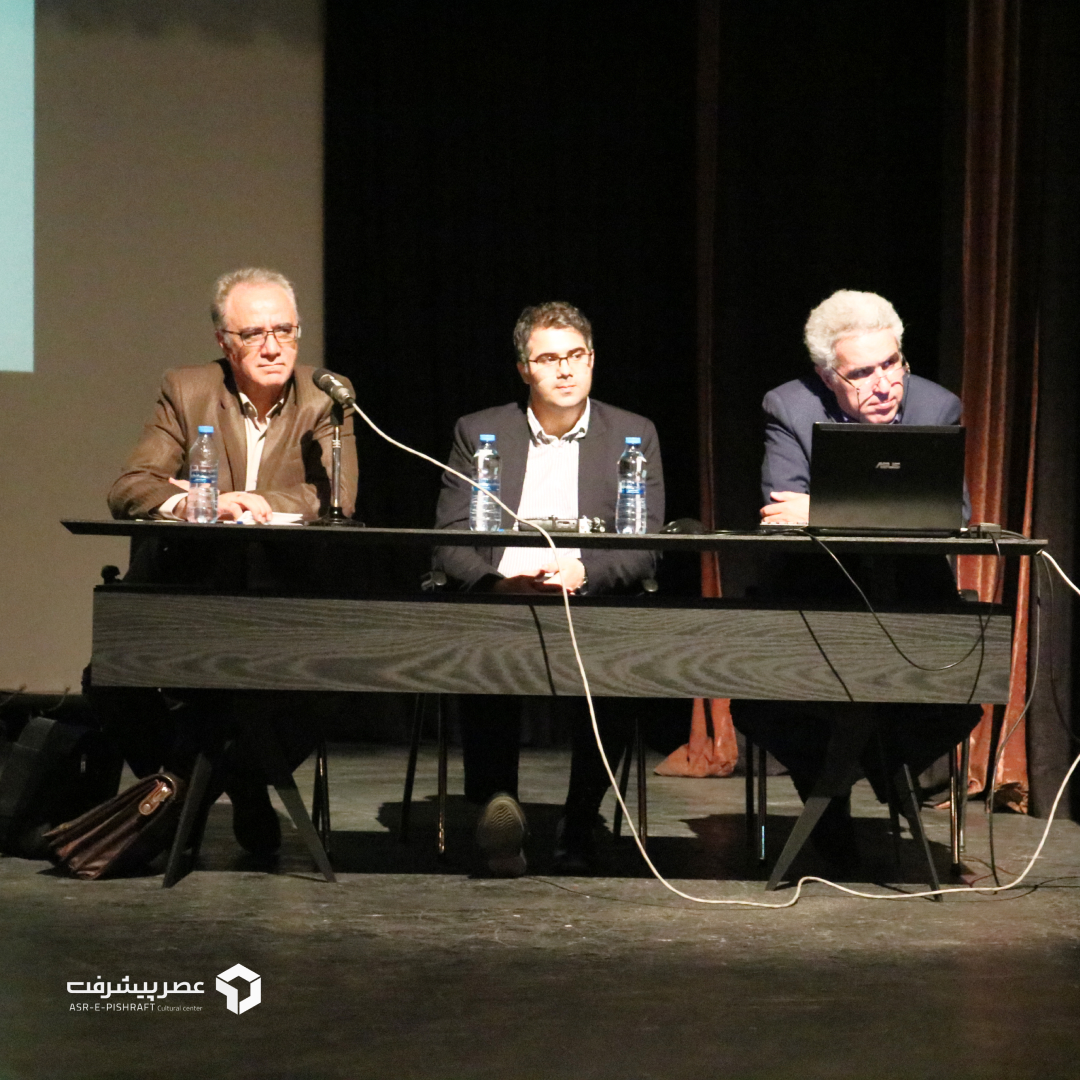
At the first session, Dr. Esfandiar Zarbakhsh, a professor at the Faculty of Urban Planning, University of Tehran, one of the pioneers of regional planning as an academic field in Iran, and someone with experience in preparing spatial planning and regional physical development plans, participated alongside Dr. Mahmoud Olad, an economist, researcher, and lecturer in urban and regional economics with experience in providing academic supervision for regional spatial planning projects.
At the beginning of the session, Dr. Zarbakhsh described the history of regional development in Iran and pointed out several important milestones in its formation. Regional development in Iran began alongside the seven-year and five-year development plans. In this context, development organizations were established in different parts of the country in order to promote regional development in those areas.
The next milestone was the establishment of technical departments in the provinces, which were created after the Third Development Plan. These departments were intended to identify regional needs and prepare plans for the provinces. In 1964, when the Ministry of Development and Housing was established, these departments were transformed into provincial offices of the Ministry of Development and Housing.
In 1971, following the approval of the Law on Councils and Provinces and the transfer of certain responsibilities and decision-making powers to the provinces, and, most importantly, the division of the country's 23 provinces into eleven planning regions by Professor Mohammad Hamsi of Shiraz University, carried out in coordination with the Battelle Institute, the planning system shifted from sectoral planning toward regional planning.
He also discussed the establishment of the High Council of Architecture and Urban Planning, which had begun its activities in 1967 but was formally established in 1973.
Challenges to Regional Development Planning
Dr. Zarbakhsh then addressed the challenges facing regional development plans. He identified the first major challenge, prior to the Revolution, as institutional duplication and disagreement between the Plan Organization and the Ministry of Housing in 1974.
He explained that, following the change in the name of the Ministry of Development and Housing to the Ministry of Housing and Urban Development, legislation was also adopted assigning responsibility for preparing the national spatial planning scheme to the Ministry of Housing and Urban Development and requiring all subordinate institutions to comply with it as an overarching plan. Naturally, the Plan Organization was dissatisfied with this approach.
Regarding the development of regional plans, he referred to the Regional Planning Office of the Plan and Budget Organization, which was established after the Islamic Revolution and undertook studies related to the Islamic Spatial Planning Plan. The results were prepared in two books comprising several volumes under the title Islamic Spatial Planning Plan.
The Ministry of Housing and Urban Development had also prepared the Atlas of Urban and Regional Planning of Iran. These differences of opinion and parallel expenditures were also undesirable from the government's perspective. Ultimately, it was decided that the High Administrative Council of the country should be tasked with separating the responsibilities of the two institutions.
In its 1992 resolution, the High Administrative Council assigned spatial planning, understood as determining strategies and distributing population and activities across the national territory, to the Plan and Budget Organization, while responsibility for preparing national and regional physical development plans was assigned to the Ministry of Housing and Urban Development.
Dr. Zarbakhsh identified the most important obstacles to the implementation of regional plans, particularly at the pre-implementation and planning stages, as the lack of seriousness surrounding these plans and their excessive dependence on individuals, both within the Ministry of Housing and within the Plan and Budget Organization; the failure to regularly update regional development plans; the weak institutional position of the High Council of Architecture and Urban Planning; insufficient inter-agency interaction and the reactive behavior of government agencies; the absence of meaningful participation, understood as the involvement of citizens, professional associations, and local officials in shaping these plans; the absence of an independent institutional structure responsible for spatial and regional plans; the lack of clearly defined objectives; the overly broad scope of services; and the absence of clearly designated responsible institutions.
At the implementation stage, he identified the main obstacles as the absence of mechanisms for implementation, lack of follow-up, inadequate dissemination of information to ensure that other institutions were aware of the plans, and insufficient access to regional development plans.
Dr. Olad's Proposals
Dr. Olad concluded this part of the discussion by presenting his proposals for overcoming these obstacles.
He stated that, in general, several scenarios could be pursued. One option would be to continue and firmly pursue the national physical development plan as a consistent and serious process, avoiding fragmentation and inconsistency with other plans.
Another option would be to examine higher-level documents, including the Vision Document, together with lower-level documents, and develop the national physical development plan through an iterative process between these different levels.
A third option would be to merge spatial planning and physical development planning into a single plan. Another possibility would be to establish an institution within the Plan and Budget Organization specifically responsible for spatial planning; in that case, there would no longer be a need for separate physical development plans.
Regional Planning from an Economic Perspective
Following Dr. Zarbakhsh, Dr. Olad presented his arguments from an economic and more fundamental perspective.
He first addressed the rationale and necessity of regional planning and the basic premise of regional planning: Could the market not regulate itself and achieve the best and most efficient allocation of resources, making planning unnecessary?
In response, he discussed issues related to market failure in the provision of public infrastructure, externalities such as air pollution and environmental degradation, and the lack of spatial interaction in the sense of excessive or insufficient use of land for the allocation of activities.
Dr. Olad then referred to the main approaches to planning and stated that there are three major approaches: the socialist approach; reforming incentive structures through negative measures, such as taxation and prohibitive regulations, and positive measures, such as subsidies; and the coordination approach.
Four Dimensions of Regional and Spatial Planning
He examined the main issues of regional and spatial planning across four dimensions: activities, settlement, space, and the relationships among these three dimensions.
Activities
In the activity dimension, he identified the main problems as a mono-product economy; failure to connect to global corridors; one-sided dependency; dependence on past advantages; severe weaknesses in creating value chains and building brands around activities; failure to integrate into global activities and value chains; price manipulation; declining global competitiveness; an unconventional business environment; state-oriented production; a rent-based economy; the export of raw materials; and the expansion of the informal economy, including unlicensed economic activities undertaken to evade taxation and other obligations.
Settlement
In the settlement dimension, he focused specifically on housing poverty.
He referred to informal forms of settlement, including sleeping in cardboard boxes, two households living in a single housing unit, sleeping on rooftops, and other forms of housing deprivation—eight forms identified by the Research Center of the Islamic Consultative Assembly—and emphasized their increasing prevalence and the need for planning responses.
Space
In the spatial dimension, he identified ecosystem instability, dust storms, forest destruction, and waste disposal as the main issues.
Relationships among the Three Dimensions
Regarding the relationships among these three dimensions, he highlighted several important issues: the severe concentration of population in the central region; the strong attractiveness of the center and the tendency for everything to ultimately converge on Tehran; the conflict between spatial planning objectives and justice; the very limited role of regions in decision-making; the excessive breadth of the scope of services in planning studies—which was initially necessary but whose continuation is no longer appropriate—and the need to reduce the time required to complete spatial planning schemes.
Why Are Regional Development Plans Not Implemented?
At the end of the session, the speakers addressed the central question of the meeting: Why have these plans not been implemented?
They argued that the first question should be: Whose interests are threatened by the implementation of these plans?
In their view, the government and the governing system themselves constitute one of the obstacles, because their interests may be threatened by the implementation of development plans. The government's interests lie in the concentration of power—particularly decision-making power—and wealth, whereas development plans have generally been formulated around decentralization and the redistribution of power away from the center.
In addition, governments tend to seek a high degree of control, particularly in countries where there is potential for protest and unrest. Ideological conflicts were identified as another factor preventing governments from implementing development plans.
In addition to the government and governing institutions, they identified various agencies and sectors, whose incentive structures are primarily oriented toward advancing their own organizational interests; members of parliament, who are concerned with winning votes and consequently promoting caricatured or distorted forms of development in their constituencies; and the institutional interests and property holdings of different organizations and agencies—for example, a hospital seeking to develop a commercial complex on its unused land—as other obstacles to the implementation of development plans.
The organizations responsible for implementing spatial planning schemes themselves were also identified among the institutions that can hinder their implementation.
The schedule for the upcoming sessions will be announced soon.

